

The Big Number Is Not the Whole Story
More than 290,000 homes are scheduled for completion in Dubai in 2027 and 2028, according to Cavendish Maxwell. To many investors, that number sounds like a warning. No wonder Dubai property oversupply has become one of the most common worries among overseas buyers in 2026.
But the headline number tells only part of the story. In Dubai, scheduled projects rarely reach the market exactly on time. At the same time, the population is growing at a near-record pace. And the risk itself is not spread evenly across areas and property types.
This guide explains how much supply is actually likely to arrive, where pressure is building and how to check a property before you buy. It is written for Israeli investors buying remotely who need reliable data.
What Is Dubai Property Oversupply?
Oversupply happens when more similar properties reach the market than tenants and buyers can absorb at current prices. As a result, rents and resale prices fall in that segment. It is usually local, hitting particular buildings, areas and unit types rather than the whole city.
Oversupply is not just a number in a report about future projects. It shows up in practice when too many similar homes compete at the same time.
Picture a new tower with hundreds of one-bedroom apartments, many bought by investors. At handover, dozens of owners list almost identical units within a few weeks. One landlord asks AED 100,000 a year. A second gets no enquiries and drops to 95,000. A third, who has a mortgage payment to meet, accepts 90,000.
Suddenly the bargaining power shifts to the tenant. The same thing happens on resale, when buyers look for the seller under the most pressure to close. That is what real oversupply looks like.
Two terms help when reading the data:
- Scheduled supply: units developers plan to complete in a given year.
- Delivered supply: units actually completed and handed over to owners.
The gap between the two is the key to reading any oversupply forecast.
How Much New Supply Is Really Coming to Dubai?
Scheduled vs Delivered
Scheduled handover dates in Dubai are not a very reliable guide to actual completions. Projects are delayed by contractor capacity, supply chains and infrastructure timelines. A December handover can slip to March, and then to June.
The 2026 data shows why headline oversupply forecasts tend to run ahead of actual deliveries. Research firms also count completions differently, so their figures are not identical.
According to official Dubai Land Department (DLD) data, 24,537 residential units were added in the first half of 2026, as reported by Khaleej Times. Cavendish Maxwell counted about 24,800, and Reliant Surveyors close to 29,000. At the start of the year, ValuStrat estimated the 2026 supply pipeline at 131,234 units, but noted that annual delivery forecasts have historically been revised because of construction timelines. By mid-year, the picture looked very different:
| Measure | Figure | Source |
|---|---|---|
| Units delivered in H1 2026 | About 24,800, up 37.6% year on year | Cavendish Maxwell |
| Share of H1 scheduled units completed | 41.3% | Cavendish Maxwell |
| Units scheduled for H2 2026 | About 47,000 | Cavendish Maxwell |
| Expected actual deliveries in H2 | 14,000 to 23,500 | Cavendish Maxwell |
| Full-year 2026 delivery forecast | About 55,600, the most since 2008 | Cushman & Wakefield Core |
Much of the long-term pipeline is still far from completion. Of about 525,000 units planned to 2030, only about 186,000 have passed 20% construction progress, according to Cushman & Wakefield Core.
Delays Push Supply Back, but Don't Remove It
Delays alone don't solve the oversupply question. Delayed homes don't disappear; they move into later years. Cavendish Maxwell counts about 162,500 units scheduled for 2027 and another 128,200 for 2028.
Even if only some are delivered on time, Dubai will need to absorb a large number of homes. The supply wave is real, but it is likely to be spread over more years than the headlines suggest.
Senior market figures also expect some adjustment. Emaar founder Mohamed Alabbar said in September 2026 that prices could correct by 5% to 10% as new supply arrives through 2027. He added that the market could recover quickly once the regional situation settles, as reported by Khaleej Times.
Can Population Growth Absorb the New Homes?
Demand-side numbers are striking too. According to Digital Dubai, the emirate's population reached 4.58 million at the end of 2025, an increase of about 332,000 residents, or 7.5%, in one year. The Dubai Population Clock showed more than 4.74 million residents at the end of July 2026.
Of course, 332,000 extra residents do not need 332,000 extra homes. Families live together, many people share housing, and household sizes vary. Still, the figure matters: Dubai is building for a fast-growing city, not a static population.
For scale, Dubai's total housing stock stood at about 935,000 units at the end of 2025, and about 46,700 units were delivered that year, according to Khaleej Times. Even a strong delivery year adds only about 5% to 6% to existing stock.
So the picture changes from year to year. Sometimes deliveries run ahead of population growth and rents soften, and later population growth closes the gap. A sweeping claim that the whole city is, or is not, oversupplied can mislead investors.
Where Is the Risk Concentrated?
Much of the Supply Is Small Apartments
The mix of supply matters more than its size. These are the figures Cushman & Wakefield Core presented in February 2026:
- Location: Nearly 45% of under-construction stock is concentrated in five areas: Jumeirah Village Circle and Triangle, Dubai South, Mohammed Bin Rashid City, Business Bay and Dubailand Residence Complex.
- Unit type: About two-thirds of upcoming units are studios and one-bedroom apartments.
- Property type: Apartments make up more than 86% of future supply, compared with about 80% of existing stock.
- Near-term deliveries: Apartments are expected to make up more than 82% of deliveries in the second half of 2026, according to Cavendish Maxwell.
The highest risk sits where these factors overlap: small, standard apartments in areas with a large number of upcoming handovers.
The Gap Between Property Types Is Already Showing in Prices
Price data already points to pressure on apartments. According to ValuStrat's index, apartment values in July 2026 were 4.2% lower than a year earlier. Villa values, by contrast, held broadly stable.
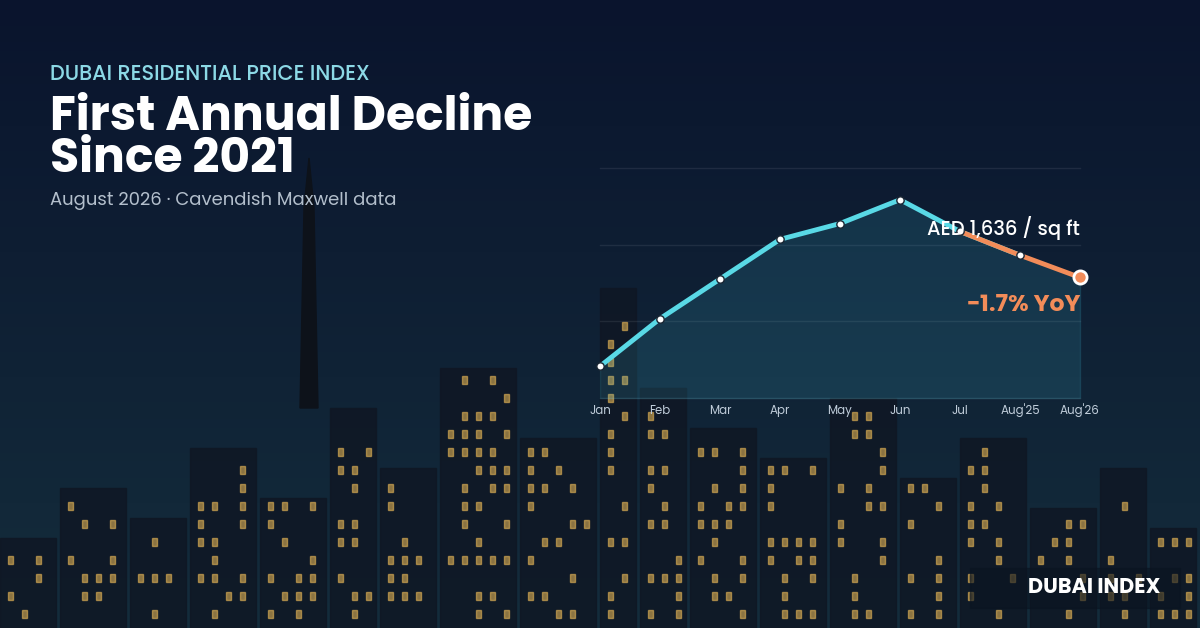
In August, apartments fell 5.3% year on year. Villas fell 1.7%, their first annual decline since 2021. Citywide values were about 10.2% lower than in February. Part of that fall came during the regional conflict earlier in 2026, when Emaar's cancellations also rose, so it does not reflect supply alone.
The differences between communities are large. In August, apartment values in Burj Khalifa were about 20% lower than a year earlier, while Dubai Silicon Oasis apartments were still about 4% higher. Villas are not immune either, with notable falls in Mudon and Dubai Hills Estate. Even so, most communities held their value in August: 61% of apartment communities and 73% of villa communities.
Quick Off-Plan Flips Have Become Harder
Investors who buy to sell quickly are often the first to feel oversupply. The data supports this: according to Cavendish Maxwell, in the first half of 2026 primary off-plan sales by developers fell only 1.5%, to about 54,700 deals. Off-plan resales, by contrast, fell about 51%, to about 4,600.
Buyers are still interested in well-chosen new projects, but buying and reselling at a profit within six months has become much harder.
Higher vs Lower Exposure
| Higher exposure to oversupply | Lower exposure to oversupply |
|---|---|
| A standard studio or one-bedroom in an area with many handovers | A villa or townhouse in an established, largely built-out community |
| A building where many units were bought to flip | A community with a high share of owner-occupiers |
| A unit with no particular edge in layout, view or finish | A rare property type that is hard to replicate nearby |
| An owner who must sell or rent at the same time as the neighbours | An owner who can hold through a weak period |
This is not a claim that every apartment will fall or that every villa is safe. It is a quick way to assess a specific property's exposure.
How to Check the Risk for a Property You're Considering
The useful question is what is being built around the property. You can check it in seven steps:
- Map the competing supply. How many units will be delivered in the same community over the next two to three years? The Dubai Index handover tracker is a good starting point.
- Compare unit types. Are these units like yours, such as studios and one-bedrooms, or a different product?
- Check actual progress. Use the DLD's project status service, not just the date in the marketing.
- Identify the target market. Is there real demand from families and professionals, or mainly from investors?
- Stress-test the rent. For comparison, Cavendish Maxwell reported gross yields of about 7% for apartments and about 5% for villas in the first half of 2026. What happens to your yield if rents fall 5% to 10%?
- Plan the exit. What happens if you need to sell at the same time as dozens of neighbours?
- Compare with ready property. Is the off-plan price justified compared with completed properties nearby?
5,000 new units elsewhere in Dubai may mean nothing to you. 5,000 similar one-bedroom apartments being delivered next door could change the picture completely.
Extra Checks When Buying From Israel
Oversupply is harder to spot when you buy remotely. You usually cannot walk the area, count cranes or talk to local tenants. That is why you need to rely on verified data.
Ask the agent for a list of nearby projects and their handover dates, and verify it yourself with the DLD. You can contact its virtual assistant on WhatsApp at 8004488.
Work only with RERA-licensed brokers. You can compare options in the Dubai Index directory of vetted agencies. Also make sure contracts are reviewed in a language you understand well, because property rules in the UAE differ from those in Israel.
At Dubai Index, we see remote buyers focus on the payment plan and forget to plan the exit. In a more balanced market, that detail matters even more.
A Market Where Property Selection Matters More
Four Signs That Oversupply Could Spread Citywide
Local oversupply is already visible in some areas. For it to become a broad citywide problem, several signs would probably need to appear together:
| Sign | What to check | Status as of September 2026 |
|---|---|---|
| A sharp acceleration in completions | Deliveries approach scheduled numbers, rather than about 40% to 50% of them | Not yet: 41.3% of H1 scheduled units were delivered |
| Slowing population growth | Annual growth falls well below recent levels | Not yet: 7.5% growth in 2025 and continued growth in 2026 |
| Broad rental weakness | A sustained citywide fall, not just in certain areas | Early signs: average rents in Dubai fell 6% in Q2 2026 from the previous quarter, according to Cushman & Wakefield Core |
| Rising distressed sales | Many investors trying to sell at once | No clear sign: Emaar's cancellations fell to about 550 after the ceasefire, according to the company's founder |
Each sign on its own can be manageable. All four together would make the risk much more significant.
Is This Like 2008?
Many Israeli investors remember 2008, when Dubai property prices collapsed. Today's market has safeguards that were not in place in the same form then. Under Dubai Law No. 8 of 2007, off-plan payments must go into project-specific escrow accounts. In addition, the Central Bank has capped mortgage loan-to-value ratios since 2013. A large share of purchases is also made in cash, so fewer owners are forced to sell when prices fall.
None of this rules out a price correction, but it makes a 2008-style crash less likely. Oversupply is more likely to show up as local pressure on prices and rents.
What Does It Mean for Investors?
Can oversupply push prices down? In some buildings and segments, it already has. But the claim that "290,000 homes are coming, so Dubai will crash" ignores two facts: completion dates are unreliable, and the population keeps growing fast.
The more likely outcome is a more selective, less forgiving market. Rents for some properties have fallen, and some towers will have many competing listings. Scarce properties in strong locations, by contrast, are better placed to hold their value.
For investors, the period when it was easy to ride the boom is probably over. Opportunities in Dubai still exist, but the focus is shifting to choosing the right property. For more, read Is buying off-plan in Dubai still worth it in 2026? For a data report on a specific area, see our market analysis service.
Worried About Oversupply Near the Building You're Considering?
Dubai Index can help you check upcoming handovers nearby and compare the apartment with ready properties. We can also connect you with vetted agencies before you commit.
FAQ
Is there Dubai property oversupply in 2026?
Not citywide. Deliveries in 2026 are expected to total about 55,600 units, high by historical standards but far below the scheduled supply in the headlines. The risk is concentrated in small apartments in a few areas.
How many units are scheduled for 2027 and 2028?
Cavendish Maxwell counts about 162,500 units for 2027 and 128,200 for 2028. However, usually only part of scheduled supply is completed on time. In the first half of 2026, only 41.3% of scheduled units were delivered.
Will oversupply push prices down?
Some segments have already corrected. In August 2026, ValuStrat recorded annual falls of 5.3% in apartment values and 1.7% in villas. Emaar's founder estimated a possible 5% to 10% correction as supply arrives through 2027.
Which areas have the most new supply?
Nearly 45% of under-construction stock is in Jumeirah Village Circle and Triangle, Dubai South, Mohammed Bin Rashid City, Business Bay and Dubailand Residence Complex. That doesn't mean every property there will fall, but competing handovers need careful checking.
Are villas safer than apartments?
Villas have held up better because they face less pressure from Dubai property oversupply. Only a small share of new supply is villas. Even so, in August 2026 they recorded their first annual decline since 2021.