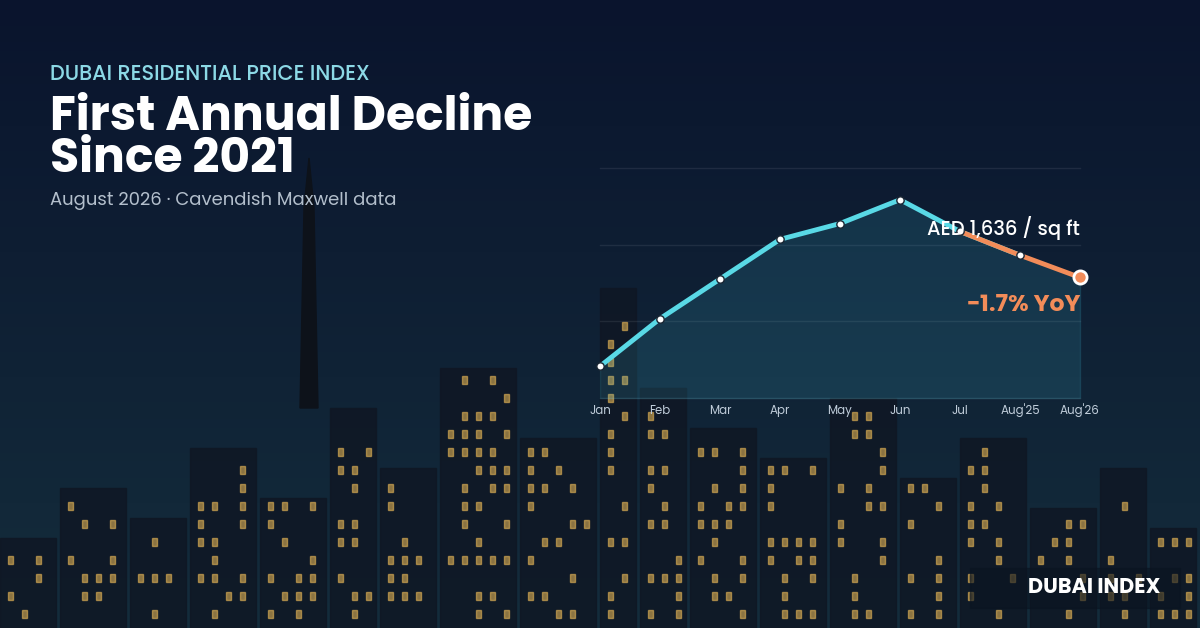


Dubai house prices fell year-on-year in August 2026 for the first time since February 2021, according to new data from property consultancy Cavendish Maxwell. Average sales prices dropped to AED 1,636 per square foot — down 1.7% from August 2025 and 1.3% lower than the previous three-month period.
What the Dubai House Prices Data Actually Shows
The headline number is a price dip, but the fuller picture is more mixed than "boom over" framing suggests:
- Prices: down 1.7% year-on-year, the first annual decline since the pandemic-era trough of early 2021.
- Sales activity held up: residential transactions totaled AED 23.4 billion in August, bringing year-to-date sales to nearly AED 270 billion.
- Volume softened seasonally: around 10,900 homes changed hands in August, about 14% fewer than in July — consistent with the usual summer slowdown rather than a sudden stop.
- Off-plan still dominates: roughly 75% of August sales were off-plan units, showing developers and buyers are still actively transacting on new supply.
- Year-to-date transaction value is down 24% compared with the same period in 2025, reflecting the broader cooling from 2025's exceptionally strong run.
Cavendish Maxwell's Ronan Arthur, Director and Head of Residential Valuation, described the shift as a transition to a more measured, mature market phase after a prolonged period of unusually strong sales and price growth, while noting that the underlying demand drivers for Dubai real estate remain intact.
Separately, Emaar Properties founder Mohamed Alabbar suggested at the AIM Congress in Dubai that incoming supply could bring the market into better balance, and flagged that regional geopolitical factors could contribute to a price adjustment in the range of 5–10%.
Why This Matters for Israeli Investors
- This is not a crash signal. A 1.7% annual dip alongside AED 23.4bn in monthly sales activity points to normalization, not a market in trouble. Treat single-month price softening as one data point, not a trend to act on impulsively.
- Off-plan buyers should recheck their entry pricing. If you locked in an off-plan unit during 2024–2025's peak pricing, it's worth comparing your purchase price against current per-sqft averages for your area/project to understand where you stand on paper — not to panic, but to plan.
- This may be a better window for negotiation. A cooling market with softer summer volumes can mean more room to negotiate on ready units or secondary-market resales than during the 2024–2025 seller's market.
- Watch the next few months, not just this one. A single month of year-on-year decline after years of sustained gains is exactly the kind of data point that needs 2-3 more months of confirmation before drawing conclusions about direction.
What to Watch Next
Cavendish Maxwell's fuller quarterly and annual breakdowns typically follow monthly snapshots like this one with more granular, area-level detail — worth watching for confirmation of whether this is broad-based softening or concentrated in specific segments (e.g., ready vs. off-plan, or specific communities).
If you're weighing whether now is a good entry point or want a second read on your existing off-plan position, Dubai Index's market data tools can help you check where your specific project or area stands. Our team is also available on WhatsApp if you'd like a quick, no-pressure read on your situation.
Source: Cavendish Maxwell residential market data, reported by Khaleej Times, September 8, 2026