

Fewer sales, milder price falls
Dubai property sales fell sharply in the third quarter of 2026: residential sales value dropped 47% year on year, according to a report by consultancy Cavendish Maxwell published in early October.
At the same time, ValuStrat's September price index shows that the decline in property values has almost stopped. The picture points to a shift from a fast correction to a slower market, in which buyers have more leverage.
Dubai property sales in Q3, by the numbers
According to The National's coverage of the Cavendish Maxwell report, Dubai recorded about AED 72.6 billion in residential sales between July and September 2026, across about 34,000 transactions. Off-plan purchases remained the main driver of activity.
| Residential sales, Cavendish Maxwell | 2026 figure | Change vs 2025 |
|---|---|---|
| Q3 sales value | AED 72.6 billion | down 47% |
| Q3 number of transactions | approx. 34,000 | down 38% |
| Off-plan share of Q3 sales value | 65% | not stated |
| Off-plan share of Q3 transactions | 72% | not stated |
| January–September sales value | AED 292 billion | down 27% |
| January–September number of transactions | 112,580 | down 23% |
These figures cover residential sales only. Across all transaction types, including mortgages, gifts and commercial property, the total for the first nine months reached AED 574 billion. Of that, AED 379.4 billion was sales, as detailed in our review of transactions for January–September 2026.
Why did buyers slow down?
The slowdown is largely linked to the regional conflict that began in late February 2026. According to Cavendish Maxwell, buyers became more calculated in the weeks and months after it started.
A separate report by S&P Global Ratings, also based on Dubai Land Department data, found that the average monthly number of sales between March and September was 12,644. That is 26% below the January–February average of 17,198, according to the same report in The National.
There is also a technical factor. Cavendish Maxwell noted that the quarterly figures mix new and older purchases, because of the gap between agreeing a deal and registering it with the Land Department. Part of the decline seen in Q3 therefore reflects a slowdown that began months earlier.
Prices: a correction, then stabilisation
Prices fell, but far less than activity did. ValuStrat's Q2 2026 review showed a second consecutive quarterly fall in the residential index, of 4%, after the regional events earlier in the year. Since then, the declines have almost stopped.
According to ValuStrat's September 2026 index, the index stood at 218.6 points, with a monthly change of just 0.1%. Year on year, values were down 4.5%: apartments fell 6.4% and villas 3.4%.
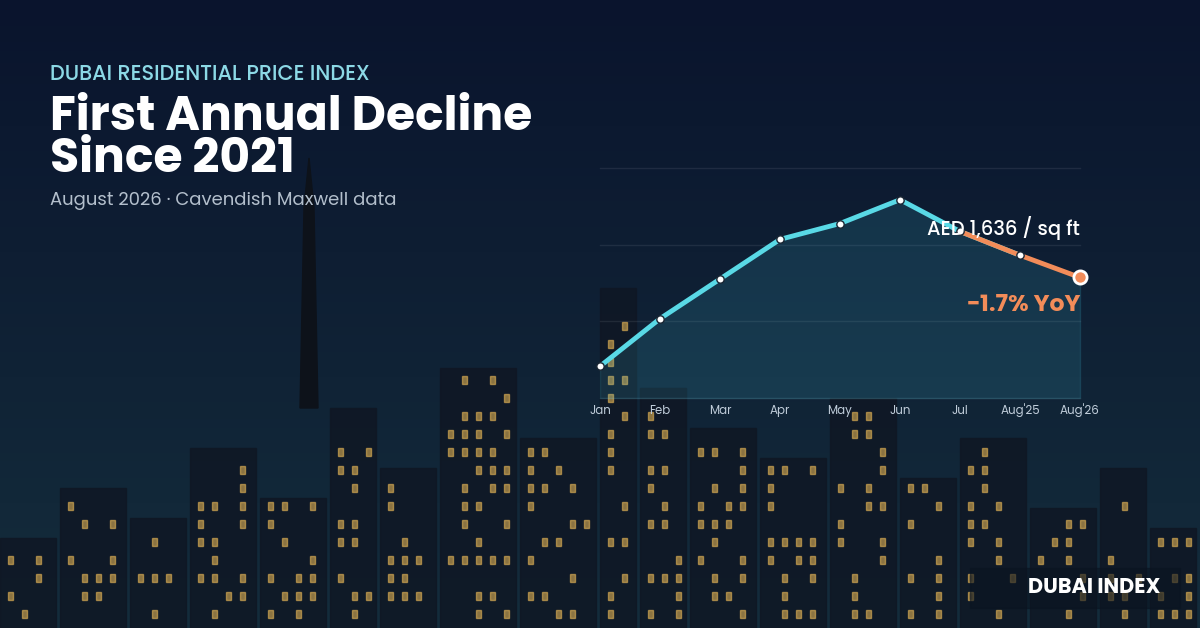
Separately, Cavendish Maxwell data showed that in August the average sale price recorded its first annual decline since 2021, as we covered in our article on the first annual fall in Dubai house prices since 2021.
According to The National, S&P estimates that prices fell 5–15% between the end of 2025 and September 2026, depending on the segment. It expects a gradual correction, with apartments likely to weaken more than villas because of their larger supply pipeline. It also expects more secondary-market activity as some investors choose to sell.
Emaar founder Mohamed Alabbar estimated a 5–10% correction in early September. Later that month, in an interview with Reuters, he narrowed his forecast to an average decline of about 5% in 2026, as we detailed in our article on Emaar's price forecast.
Activity has not stopped
Despite the weak quarter, the market is still operating at scale. According to Dubai Land Department data published by Arabian Business, transactions worth AED 13.47 billion were recorded between 12 and 16 October.
That figure includes 2,676 sales. For the full breakdown, see our review of transactions for 12–16 October.
What it means for Israeli investors
The following is an analysis of the data, not a forecast.
More room to negotiate. With fewer buyers competing for properties and sales taking longer, the buyer's position is stronger than during the 2023–2025 boom, especially on the secondary market.
Apartments and villas are behaving differently. ValuStrat data already shows a steeper fall for apartments. S&P expects the gap to persist in areas with large supply. The choice of area and project carries more weight.
Off-plan still leads, so due diligence matters. About seven in ten purchases are off-plan. Check the developer's handover history and construction progress. Our handover tracker is a good starting point.
Allow for the registration lag. Quarterly sales data trails actual activity. Monthly price indices, such as ValuStrat's, give a more current picture of values.
To compare prices across the main areas, see our price index. For a tailored review of a project or neighbourhood, see our market analysis service.
Does the slowdown make this a good time to buy?
The Dubai Index team can go through current prices, secondary-market options and off-plan projects in the areas you are considering. Leave your details and we will get back to you: contact us or send us a WhatsApp message.