

Alabbar Expects Dubai Property Prices to Fall 5% on Average This Year
The Dubai property price forecast from Emaar founder and chairman Mohamed Alabbar is an average 5% fall this year. He said so in an interview with Reuters on Monday, 21 September 2026. Alongside the forecast, Alabbar gave two further updates: occupancy at Emaar's hotels in Dubai is back to about 60%, and the company's revenue backlog exceeds $50 billion.
Dubai Property Price Forecast: What Did Alabbar Say?
In the Reuters interview, Alabbar linked the price forecast to the regional conflict: the war that began on 28 February 2026 with US and Israeli strikes on Iran, during which Iran launched missile and drone attacks on several Gulf states, including the UAE. A ceasefire has been in place since 8 April. These are the main points, as published by Gulf Times:
- Property prices: an average fall of about 5% in Dubai this year.
- Emaar hotel occupancy: about 60% now, compared with 83% before the conflict and 20–25% at the low point. Alabbar expects occupancy to return to normal levels within about 12 months, helped in part by more international flights.
- Emaar's revenue backlog: more than $50 billion. He said collections from buyers are going well, in line with 2025.
How Does This Forecast Compare With His Earlier Estimates?
This is not the first time Alabbar has put a number on the expected decline. In early September he told The National that he expects a 5–10% correction in Dubai property prices, and that in 2027 the market should reach a good balance as new units are handed over. His latest forecast sits at the low end of that range.
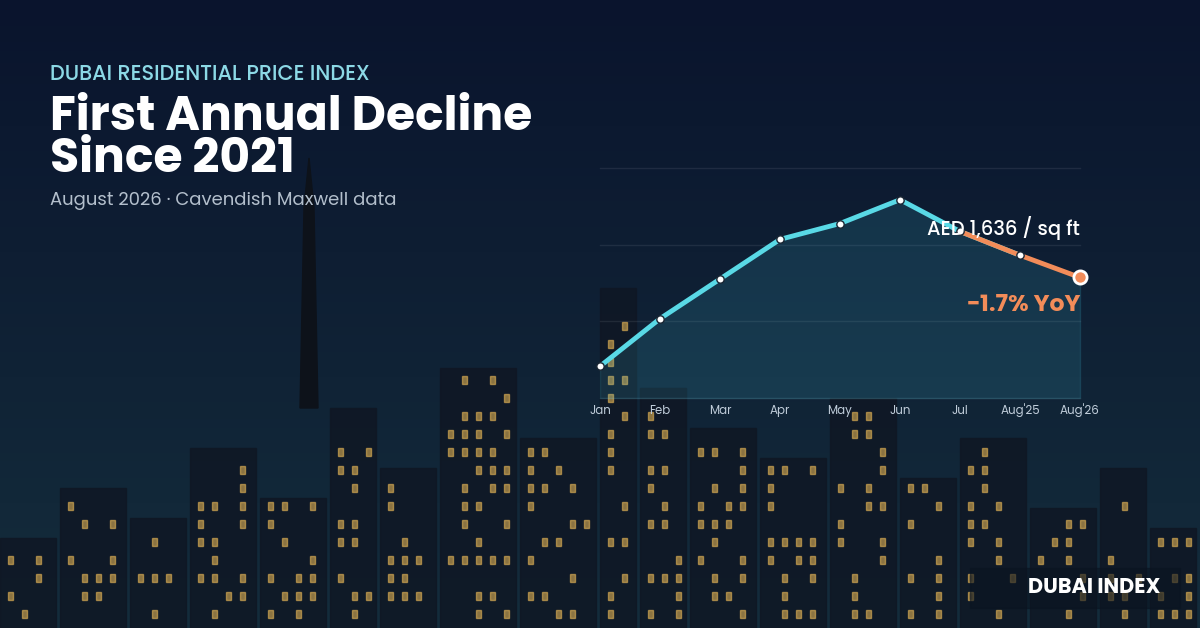
Independent data suggests prices are already softening. Consultancy Cavendish Maxwell found that the average price per square foot in Dubai in August 2026 was 1.7% lower than in August of the previous year, the first annual decline since 2021. We covered the data in detail in our article on the first annual fall in Dubai property prices since 2021.
With prices only 1.7% lower year on year in August, Alabbar's 5% forecast for the year implies that, in his view, the decline will deepen in the coming months.
According to Khaleej Times, Alabbar also said cancellations at Emaar rose during the conflict from an average of about 700 to about 1,000, and fell to about 550 after the ceasefire.
The Emaar Figures Behind the Forecast
Emaar's latest official figures were published on 7 August, as part of the company's results for the first half of 2026:
| Metric, H1 2026 | Figure | Change vs H1 2025 |
|---|---|---|
| Group revenue | AED 23.9 billion ($6.5 billion) | Up 21% |
| Group net profit before tax | AED 12.8 billion ($3.5 billion) | Up 23% |
| Group property sales | AED 26.6 billion ($7.2 billion) | Down about 42%, from AED 46 billion |
| Group revenue backlog as of 30 June | AED 164.9 billion ($44.9 billion) | Up 13% |
| Emaar Development property sales | AED 22.4 billion ($6.1 billion) | Down 45%, from AED 40.6 billion |
| Emaar Development revenue backlog | AED 127.7 billion ($34.8 billion) | Up 8% |
Sources: Emaar Properties and Emaar Development H1 2026 results announcements, and Emaar's H1 2025 results announcement for last year's group sales. Emaar Development's sales figure for the same period last year is from a report by AGBI.
The latest official backlog figure published by the group was $44.9 billion as of 30 June. The figure of more than $50 billion, by contrast, is an update Alabbar gave verbally in September. Emaar has not yet published an official figure confirming the higher amount, so until the next results the official June figure is the one to rely on.
New sales slowed sharply in the first half of the year, with group property sales down about 42%, while profits kept rising thanks to the handover of properties sold earlier.
What Does This Mean for Israeli Investors?
An Average 5% Fall Hides Big Differences Between Areas
A drop in the citywide average does not affect every area equally. Downtown Dubai, Emaar's flagship district, has already cooled more than the wider market: prices there fell by about 6.8% over the quarter ending in July, as we reported in our article on Downtown Dubai property prices. Area-level data matters more than any general forecast.
This Is the Developer's Own Estimate
Alabbar heads one of the largest real estate companies in Dubai, and his forecast should be read in that context. In our view, a forecast of a mild, temporary decline coming from one of the market's leading companies is also a message to buyers. Before making a decision, compare it with independent data.
Buyers May Have More Room to Negotiate
When prices soften and some developers compete through discounts or payment plans, buyers can sometimes secure better terms. The question is whether the discount reflects a real opportunity or a weakness in the project. Our guide to spotting a good property deal in Dubai sets out what to check.
Hotel Occupancy Matters for Rental Investors Too
If you are considering a serviced apartment or a short-term rental property, the recovery in the hotel sector affects the nightly rate you can charge. The estimate that occupancy will return to normal within 12 months is Emaar's forecast, not a promise.
Dubai Property Prices in 2026 Still Depend on the Regional Situation
Alabbar himself linked the price forecast to the situation in the region. A change in that situation, for better or worse, could move prices faster than the forecasts suggest.
Want to Know How a 5% Fall Could Affect the Property You're Considering?
The Dubai Index team can help you test a specific deal against the latest price data and forecasts before you commit. Leave your details and we'll get back to you: contact us or message us on WhatsApp.
Sources
- Emaar sees Dubai hotel occupancy now at 60%, recovering within a year, Gulf Times, based on Reuters
- Emaar Properties H1 2026 results, company announcement, 7 August 2026
- Emaar Development H1 2026 results, company announcement
- Emaar's Alabbar predicts "nice balance" for Dubai property market, The National, 7 September 2026
- Dubai property prices could adjust 5–10% as new supply comes by 2027, Khaleej Times
- Emaar's huge backlog cushions sharp fall in new property sales, AGBI, August 2026
- Dubai home prices fall year-on-year for first time since 2021, Gulf Business, 7 September 2026
- Emaar Properties H1 2025 results, company announcement
- 2026 Iran war, Encyclopaedia Britannica