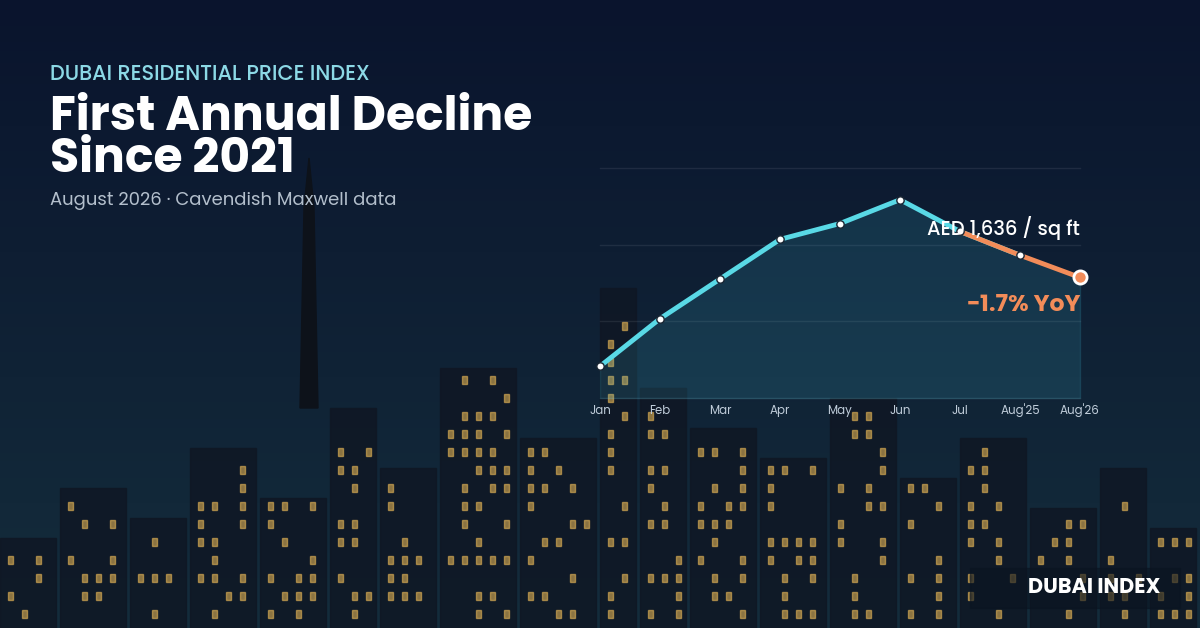


The Dubai property market cycle is back in the headlines. Prices and sales volumes broke records in 2025. In March, a regional conflict rattled buyers, and rents have started to soften since then. In August, the average price fell year on year for the first time in five and a half years.
The obvious question is whether we're heading back to 2008. This Dubai Index guide explains where the market stands today, what actually collapsed last time and what to check before you buy.
What Is the Dubai Property Market Cycle?
The market cycle is a recurring pattern of recovery, expansion, oversupply and decline in property prices. Each phase has a different driver, such as available credit, a mega-event, a wave of new construction or an external shock. Identifying the current phase helps investors gauge the level of risk.
The four phases of the cycle work like this:
- Recovery: Confidence returns after a downturn and prices start to rise gradually.
- Expansion: Demand accelerates and developers launch lots of projects.
- Oversupply: New homes enter the market faster than demand grows, so prices level off or fall.
- Recession: An external shock or pressure in the credit market deepens the decline.
Two more terms appear throughout this guide. An off-plan property is one sold before construction is complete. Handover is when the buyer receives the finished property.
How Has the Market Cycle Moved Since 2002?
Foreigners were first allowed to buy freehold property in Dubai in 2002. Gulf News's review of the first decade describes 2002 to 2006 as a period of steady growth, 2007 and 2008 as the boom years, and 2009 to 2011 as the bust.
The rise was steep. A 2009 Reuters survey cited a Morgan Stanley estimate that prices rose by almost 80% from the start of 2007 to mid-2008. The fall was sharp too. A 2011 Reuters poll put the decline in prices and rents at nearly 60% from the 2008 peak, based on the median estimate of banks and research firms.
The recovery was slow. JLL data published in Arabian Business showed that in early 2012, villa prices were still around 25% below their 2008 peak, and apartment prices around 34% below.
The next peak came around mid-2014. Prices then fell by around 25% to 30% through 2019, and the pandemic added a final drop in 2020. As a result, prices only surpassed the 2014 peak in early 2024.
Fitch later noted that residential prices rose by almost 60% between 2022 and early 2025.
| Phase | Dubai example | Main driver |
|---|---|---|
| Recovery | 2012 to 2013 | Confidence returning after the post-2008 bust |
| Expansion | 2013 to 2014 | Winning the Expo 2020 bid and strengthening demand |
| Oversupply | 2015 to 2019 | Construction outpaced demand and prices fell 25% to 30% |
| Recession | 2020 | The pandemic shock hit an already weak market |
Why Was 2008 a Credit Collapse, Not Just a Property Crash?
People often settle for the explanation that the financial crisis caused the 2008 downturn, but the mechanism matters more than the headline.
Official loan-to-value caps only arrived in 2013, with the UAE Central Bank's mortgage regulations. Many buyers were also short-term speculators rather than end users.
When global liquidity dried up, leveraged buyers couldn't complete their deals. Prices reacted with a violent drop. In other words, leveraged money was the fuel, and the property market was simply where the fire became visible.
So the key question in 2026 isn't just whether prices are high. It's more important to ask what's funding demand. Cash buyers can usually absorb a price drop; leveraged buyers struggle more. That difference shapes every market cycle.
Where Does the Market Stand in September 2026?
2025 set a record. The Dubai Land Department reported 214,912 sales transactions with a total value of AED 682.5 billion, up 18.86% in number and 30.7% in value compared with 2024.
Since then, the market has cooled:
| Metric | Latest figure | Source |
|---|---|---|
| Average price, August 2026 | AED 1,636 per sq ft, down 1.7% year on year | Cavendish Maxwell via Khaleej Times |
| Transaction value, January to August 2026 | Around 24% lower than the same period in 2025 | Cavendish Maxwell via Khaleej Times |
| Off-plan share of transactions, August 2026 | Around 75% of residential sales | Cavendish Maxwell via Khaleej Times |
| Average rents, Q2 2026 | Down 6.2% quarter on quarter | CBRE via Gulf News |
The August figure is the first annual price decline since February 2021. The rental market is also showing weakness, as growing supply gives tenants more bargaining power.
Other sources still show prices close to 2025 levels, so the index you use affects the picture you get.
How Did the 2026 Regional Conflict Affect the Market?
The March shock was real. According to Dubai Land Department data reported by Arabian Business, sales that month eased to around 12,200 transactions worth AED 42.86 billion.
Even so, on-the-ground activity held up better than the stock market. The National reported 3,570 transactions worth AED 11.93 billion between 2 and 9 March.
The recovery isn't complete yet. According to Betterhomes' Q2 report, the number of transactions in Q2 was around 31% lower than a year earlier. Still, the market absorbed a shock that might once have broken it. Three differences help explain why:
- Cash-based demand: According to Betterhomes, 61% of the deals it handled itself in Q2 were cash purchases. Cash buyers are less exposed to changes in credit conditions.
- Escrow account rules: Law No. 8 of 2007 requires off-plan payments to go into a dedicated escrow account for each project.
- Fewer launches: According to Cavendish Maxwell's report, the number of units launched in the first half of 2026 fell to around 28,000, compared with 102,000 in the same period a year earlier.
Is Supply the Real Risk to the Dubai Property Market Cycle?
If leverage is less likely to cause a crash, supply is the main candidate for the next source of pressure.
Pam Properties counts 426,182 units scheduled for handover between 2026 and 2029. Around 71% of them have already been sold. However, two facts stop the story from becoming a simple oversupply forecast.
Scheduled Units Aren't Delivered Units
Developers don't always meet their timelines. Knight Frank's Q3 2025 review found that only 60% of promised homes were completed on time between 2022 and 2024. In the first three quarters of 2025, the figure fell to 46%.
The same pattern appears in 2026. Cavendish Maxwell counted 24,800 handovers in the first half of the year, but that was only 41.3% of the units scheduled for delivery in that period.
An investor who assumes every scheduled unit will arrive on time could overestimate the competition by more than two times. On the other hand, an investor who assumes most projects will be delayed could be caught out when they're delivered. The safest approach is to check the specific building and project.
A Sold Unit Isn't Necessarily an Occupied Unit
A unit sold to an investor still needs a tenant or a new buyer after handover. So pressure builds when owners of similar units list them in the same period.
Picture a tower where hundreds of almost identical one-bedroom apartments are handed over in the same year. Owners compete mainly on price, so the building's yield can fall even while the citywide price index keeps rising.
Older properties carry their own layer of risk too: service charges, maintenance and build quality create a gap between strong and weak properties.
How Does the Dubai Property Market Cycle Affect Investor Returns?
The cycle sets the backdrop, but your personal return comes from three factors: rent, price change and holding period.
Early in the cycle, price growth delivers a bigger share of the return. In later phases, as prices moderate, rental income carries more weight.
Location changes the picture too. A Gulf News summary of Fitch's outlook notes that prime areas such as Palm Jumeirah and Downtown Dubai may prove more resilient, thanks to strong demand and limited supply.
By contrast, areas with heavy upcoming handovers will face more competition for tenants. According to valuation firm ValuStrat, around 10% of projects under construction in Dubai are in Jumeirah Village Circle and around 6% in Business Bay.
Holding period matters as well. Buyers who entered at the 2008 peak saw drops of 50% to 60% in the hardest-hit areas. Those who bought near the 2014 peak had to wait until early 2024 to see prices pass that level again.
That's why an investor planning a quick exit takes on more risk than one who can hold a property through a full market cycle.
So, Is 2026 a Repeat of 2008?
According to the data, the market cycle isn't repeating the 2008 collapse pattern. Back then, the main drivers were high leverage and a sudden freeze in the credit market.
In 2026, the pressure points are new supply entering a market where rents are softening, alongside only a partial recovery in transaction volumes after a geopolitical shock. The situation looks more like the oversupply-driven slowdown of 2015 to 2019.
This is an interpretation of the data, not a forecast.
In 2025, Fitch estimated that a moderate decline of up to 15% was possible, rather than a crash. That estimate was published before the March conflict. The actual outcome for any investor depends far more on the building, the handover year and the developer than on a citywide headline.
What Should Israeli Investors Check Before Buying in Dubai?
Distance, language and legal differences add a layer of risk for buyers from Israel. Before you commit, ask three questions about the specific property:
- What creates real demand for the location, beyond the promises in the marketing brochure?
- How many similar units are expected to be handed over nearby in the coming year?
- Who is supposed to rent or buy the property from you, and why would they choose it over another apartment in the same building?
Then keep an eye on three indicators: the monthly price index, the off-plan share of sales and asking rents on new contracts.
The exchange rate matters too, because a return denominated in dirhams can be worth a different amount in shekels over time. Our money transfer and currency service explains the options.
Dubai Index helps Hebrew-speaking investors compare verified agencies and review market analysis before making a decision.
The information in this guide is general and does not constitute personal financial advice.
FAQs
Is the Dubai property market heading for a crash in 2026?
The data isn't clear-cut. Leverage is lower than it was in 2008, and activity recovered after the March shock. On the other hand, prices have fallen year on year, rents have softened and the supply pipeline is large. The level of risk varies a lot between buildings and areas.
How long does a Dubai market cycle last?
There's no fixed length. Prices peaked in 2008 and again around mid-2014, and only passed the 2014 level in early 2024. Identifying the phase of the cycle is more useful than counting years.
Did Dubai property prices fall in 2026?
Yes, according to one of the main indices. Cavendish Maxwell reported that the average price in August 2026 was 1.7% lower than a year earlier. Other reports show prices close to 2025 levels, so it's important to check which index each source uses.
How much of the scheduled supply is delivered on time?
According to Knight Frank, the on-time delivery rate was around 60% in 2022 to 2024. In the first three quarters of 2025 it fell to 46%. In practice, the number of handovers is usually considerably lower than the number scheduled.
Are off-plan payments protected?
Under Law No. 8 of 2007, payments must go into a dedicated escrow account for the project. The escrow account protects how the money is used, but it doesn't remove handover, market or rental risk.
Want to Check a Project Against the Market Cycle?
Dubai Index checks specific projects against the expected supply pipeline, the handover year and local rental trends. Send us the project and we'll come back to you with an analysis.