

Why Know Your LTV Before You Start Looking?
Your Dubai mortgage LTV (loan-to-value) ratio is the percentage of the property's value that the bank is willing to lend you. It determines how much of your own money you'll need to bring at the start of the deal.
Knowing your expected LTV before you start searching saves time and avoids finding a property you love, only to discover you can't finance it at the ratio you were counting on.
Dubai Mortgage LTV Ratios at a Glance
| Buyer profile | First property | Second property onward |
|---|---|---|
| Resident, property under AED 5 million | Up to 80% | Up to 60% |
| Resident, property AED 5 million and above | Up to 70% | Up to 60% |
| Non-resident, any property price | Up to 65% | Up to 60% |
LTV Limits for UAE Residents
For residents, the LTV depends mainly on the property price and whether it's their first mortgage:
- First property under AED 5 million: up to 80%.
- First property AED 5 million and above: up to 70%.
- Second and any additional property, at any price: up to 60%.
There is no ceiling in principle on the property's value. A buyer with sufficient income can, for example, get 70% financing even on a property worth AED 40 or 50 million, as long as their income supports the repayments.
Practical example: A resident buying their first apartment for AED 4,000,000 may get up to 80% financing. The mortgage amount would be AED 3,200,000 and the required down payment AED 800,000.
If the same buyer chose a villa worth AED 6,000,000 instead, the maximum LTV would drop to 70% because the property price crosses the AED 5 million threshold. In that case, the maximum loan would be AED 4,200,000 and the required down payment AED 1,800,000.
LTV Limits for Non-Residents
Stricter limits apply to buyers who are not UAE residents:
- First property: up to 65%.
- Second and any additional property: up to 60%.
In principle, there's no limit on how many financed properties a non-resident can hold. In practice, each bank sets its own limit, usually between two and six properties per client.
Because the limits vary between banks, spreading loans across several lenders can significantly increase your overall borrowing capacity.
Maximum Loan Amounts
On top of the LTV, banks sometimes cap the total loan amount, mainly for non-residents.
Most mortgages in this category are capped at around AED 10 million, although loans of up to AED 20 million have been approved in particularly strong cases. Resident mortgages usually don't have the same hard cap.
Age Limits and Their Effect on the Loan Term
LTV isn't the only factor that determines how much you can borrow. Your age at the end of the mortgage term also affects how long a loan the bank will approve.
| Applicant type | Age by which the loan must end |
|---|---|
| Salaried employees | 65, and up to 70 at some banks |
| Self-employed and business owners | 70 |
| Non-residents | 65; some banks allow up to 70 for the self-employed, and a few limit it to 60 |
If you're close to the maximum age, the bank may approve a shorter repayment term. That increases the monthly repayment and may reduce the total loan amount you can get.
The Bottom Line
Your LTV and borrowing capacity depend on a combination of four factors: residency status, property value, how many properties you already own, and your age.
Clarifying these four factors before you start searching, ideally through pre-approval, will give you a stronger negotiating position with sellers and developers.
The resident LTV ratios are based on the UAE Central Bank's mortgage regulations, Circular 31/2013 and its subsequent amendments. A bank may be more conservative than these limits, but it may not offer a higher LTV. The non-resident limits and loan-amount caps reflect common bank practice rather than the regulations, so they can vary from bank to bank.
Area Spotlight: Dubai Hills Estate
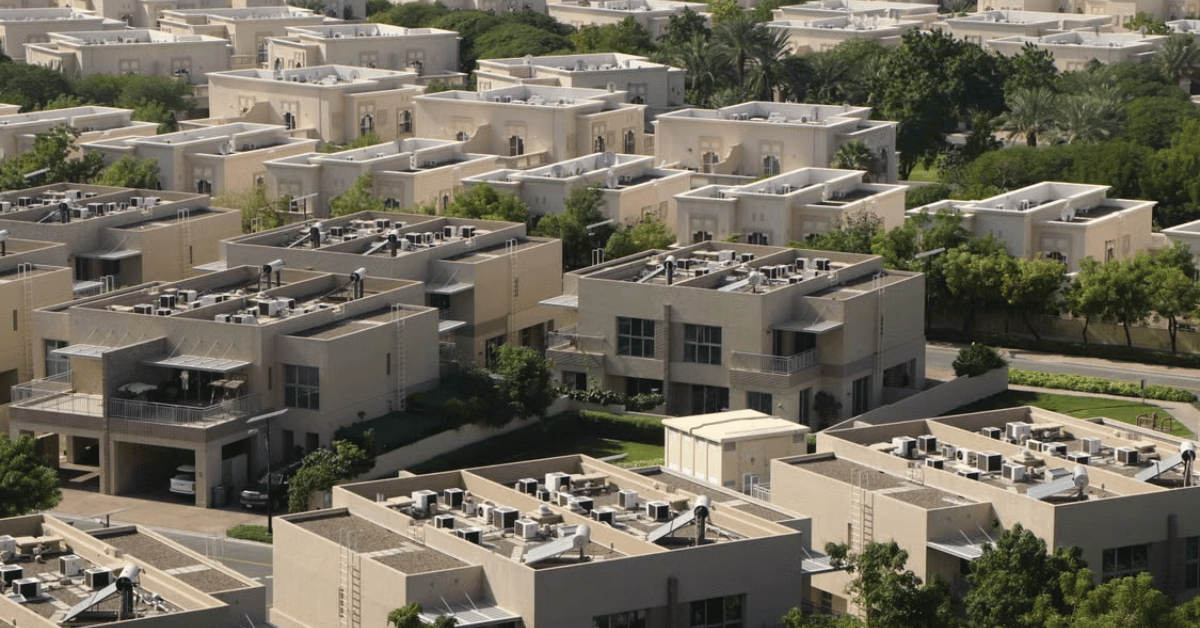
Dubai Hills Estate is an established, well-balanced area with no unusual weaknesses, so it makes a good benchmark for common financing scenarios in Dubai.
Location: 8 | Developer: 9 | Concept: 8 | Pricing: 7 | Rental: 7 | Appreciation potential: 7 | Liquidity: 7
Verdict: Because the area doesn't clearly target just one type of buyer, it lets you check whether your financing calculations are realistic before assuming a more specialized area will behave the same way.
FAQs
What is the maximum LTV I can get on a Dubai property? Up to 80% for a resident buying a first property priced under AED 5 million. That's the highest LTV available. A non-resident can get up to 65% on a first property.
Does the AED 5 million threshold refer to the property price or the loan amount? The full property price. If it's above AED 5 million, the maximum LTV on a resident's first property drops from 80% to 70%, even if the buyer is asking for a smaller loan.
Why does the LTV drop on a second property? Banks see buying a second or additional property as a higher-risk transaction, so they limit financing to 60%, regardless of residency status or property price.
Can age affect the loan amount, not just eligibility? Yes. A shorter repayment term increases the monthly repayment, so it may reduce the maximum loan amount even if the LTV itself doesn't change.
Further Reading
For the full picture, read our complete guide to mortgages in Dubai.
- Non-resident mortgages in Dubai
- Off-plan mortgages in Dubai
- The Dubai mortgage process, step by step
- Dubai Index mortgage and financing service
Want to Know Exactly How Much You Can Borrow?
Dubai Index helps buyers understand their LTV and real budget before they start viewing properties. Contact Dubai Index for a clear picture of your financing options.