

The outlook for the Dubai property market in 2027 is very different from the boom years. Sales slowed sharply during 2026, buyers became more selective, and a large wave of new homes is still on the way. Still, the slowdown is not hitting all properties equally.
Some owners are still selling at a healthy profit. Others, mainly investors who bought off-plan and planned to sell quickly, are under real pressure. The type of property you own and how you bought it now matter more than the headline about the market.
In this guide we look at the state of the market heading into the end of 2026, rank six categories of property and investment from weakest to strongest, and set out two scenarios for 2027. The aim is to help you understand where your property, or the property you are considering, stands.
What shape is the market in going into 2027?
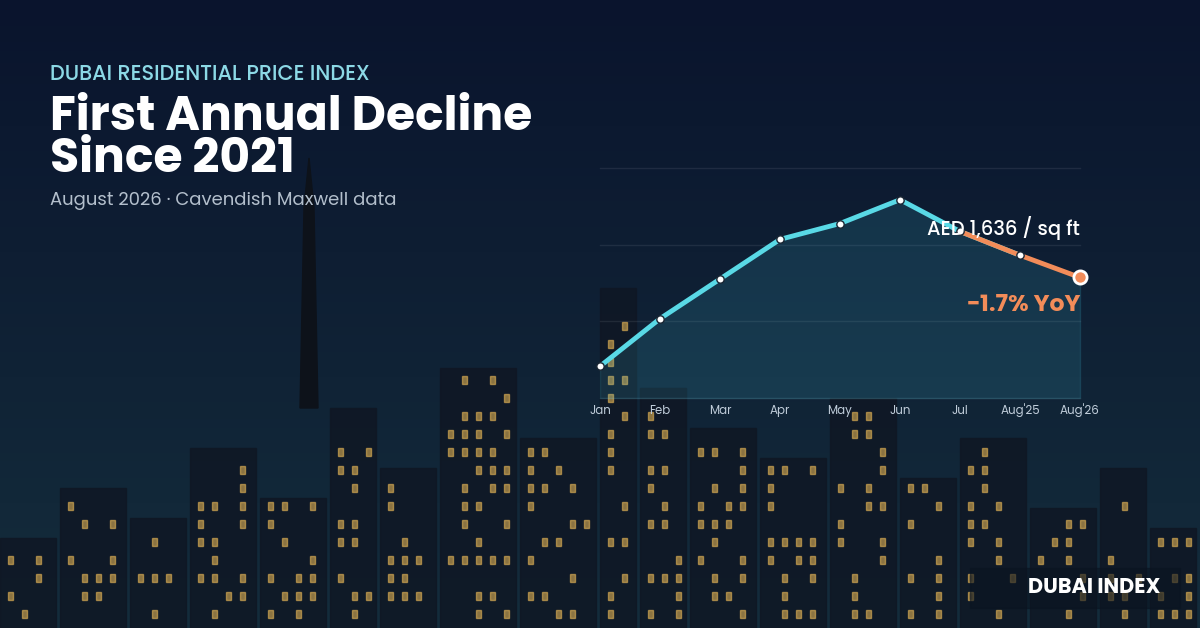
The regional conflict that began in March 2026 changed the pace of activity, and its effect is carrying into 2027. According to Cavendish Maxwell data published in Khaleej Times, residential sales in Q3 2026 reached AED 72.6 billion across about 34,000 transactions. That is a 47% fall in value and a 38% fall in the number of transactions compared with the same quarter of 2025. For the latest data, see our news on the Q3 2026 sales slowdown, the first fall in Dubai house prices since 2021 and falling rents in Q3 2026.
Prices, however, have been more resilient than volumes. According to S&P Global, prices have declined only moderately since the conflict began, thanks to long-term buyers, regulatory improvements and government support. The market has slowed and corrected, but it has not crashed.
The key shift: off-plan versus ready properties
Before comparing them, two definitions:
- Off-plan property: a unit bought from the developer before it is built, usually on a payment plan.
- Ready property on the secondary market: a completed unit you can live in or rent out immediately.
One of the biggest changes in 2026 is the balance between the two segments:
| Q3 2026 measure | Off-plan properties | Ready and resale properties |
|---|---|---|
| Share of sales value | About 65% (AED 47.1 billion) | About 35% |
| Share of transactions | 72% | 28% |
| Median apartment price per sq ft | AED 1,703, down about 5% year on year | AED 1,514, a slight annual rise |
| Sales trend | Off-plan transactions down 41.9% year on year | Ready-market transactions up 19.7% on Q2 2026 |
Sources: Cavendish Maxwell's Q3 2026 data, as reported by Khaleej Times. Median prices are from betterhomes' Q3 report.
The price premium for off-plan property is narrowing, and the ready market is showing the first signs of recovery. Even so, ready properties are not immune to declines. According to betterhomes, about three-quarters of the communities surveyed recorded a lower price per sq ft in Q3 than in the previous quarter.
Why are ready-property owners in a stronger position?
The gap between the two groups comes largely from timing and how the property was bought, and it explains much of the 2027 outlook.
Many ready-property owners bought years ago. They earn rental income, paid a lower entry price and usually do not have to sell.
Those who bought off-plan to flip usually bought closer to the peak. They are paying the developer and receive no rent until handover. Many also depend on finding a buyer before the next instalment. When buyers turn cautious, the way out of the deal narrows quickly.
The data supports this. According to Cavendish Maxwell, off-plan sales in Q3 2026 were worth AED 47.1 billion, about 65% of the AED 72.6 billion total, and the number of off-plan transactions was 41.9% lower than in Q3 2025. Ready-market transactions rose 19.7% compared with Q2 2026, but were still 28% below Q3 2025.
Handover risk
Off-plan buyers also face timing risk. If the project is delayed, or the buyer cannot complete the final payments, costs can build up while the property earns nothing. That is why it is important to check before signing what the contract says about late payments.
Also check the project's official status on the Dubai Land Department's project status service. It shows registered construction progress, which is a more reliable basis than marketing materials. Buyers abroad can also use the department's WhatsApp assistant on 8004488. Our handover tracker guide explains step by step how to check the construction completion rate and expected handover date.
Six investment categories heading into 2027, from weakest to strongest
The ranking combines property type with how it was bought. It runs from the weakest outlook to the strongest, over a horizon of about two years.
No. 6: Off-plan bought to sell before handover
Selling before handover was a successful strategy from 2021 to 2024. Today it looks the weakest. Off-plan sales have fallen faster than resale transactions: in Q3 2026, off-plan transactions were down 41.9% year on year, compared with 28% for ready-market transactions, according to Cavendish Maxwell. At the same time, the price premium of off-plan over ready property is eroding.
The 2027 handover wave will add competition exactly when many of these owners will be looking for a buyer. If you are buying off-plan now, plan to hold beyond handover. Do not count on a quick sale.
No. 5: Studios
Studios still offer the lowest entry price into the market and can generate good rental income. The weakness is capital growth potential. The price per sq ft of a studio is sometimes higher than that of larger apartments in the same building.
In addition, studios in more distant, cheaper communities are especially exposed to large amounts of new supply. You can expect steady rental income, but do not count on significant price growth when you sell.
No. 4: One- and two-bedroom apartments
These apartments make up most of Dubai's new supply, and that is exactly the problem. When the buildings now under construction are handed over, thousands of similar apartments will compete for the same buyers and tenants.
S&P Global has flagged investor-driven apartment segments as the most exposed to price corrections as a result of 2027 and 2028 handovers. Owners of these apartments may wait longer than villa owners for significant capital growth.
No. 3: Three-bedroom apartments
Larger apartments make up a smaller share of Dubai's apartment stock and appeal to families. That gives them a clear advantage over smaller units in the same building.
Still, they rank only third, because they are still part of a market about to absorb a large supply of new apartments.
No. 2: Ready properties with a sitting tenant
A ready, tenanted property earns income from day one. There is no payment plan to the developer, no construction risk and no wait for handover. The ready market is also the first to show a recovery in buying activity.
The price of this advantage is more upfront capital than a typical off-plan payment plan. Ready property prices can also fall in the short term, as the Q3 2026 data shows.
No. 1: Villas and townhouses
Villas have outperformed apartments throughout the current market cycle, and the supply picture continues to favour them:
- In 2025, Property Finder data showed a rise of about 14% in the median villa price, compared with about 6% for apartments.
- The ValuStrat index showed a 25.1% rise in villa values in 2025, compared with 14.2% for apartments.
- In mid-2025, Knight Frank estimated that only about 20% of planned supply through 2029 would be villas.
- Cushman & Wakefield Core reported a fall of about 78% in villa launches in H1 2026.
Only a small share of new supply is expected to compete directly with established villa communities. That is why villas and townhouses top the ranking for long-term holders.
Quick comparison
| Rank | Property or investment type | Main advantage | Main risk |
|---|---|---|---|
| 1 | Villas and townhouses | Limited supply and family demand | High entry price |
| 2 | Ready property with a tenant | Rent from day one | More upfront capital |
| 3 | Three-bedroom apartment | A relatively scarce apartment type | Competition from new apartments |
| 4 | One- or two-bedroom apartment | Broad tenant base | Most of the new supply |
| 5 | Studio | Low entry price | Weak capital growth |
| 6 | Off-plan bought to flip | Low initial payment | Growing difficulty selling before handover |
For a closer look at a specific villa market, read our guide to villas on Dubai Islands for Israeli investors.
Will Dubai property prices fall in 2027?
The answer depends on two factors: the regional situation and how quickly new supply is absorbed. Apartments in areas with a high concentration of investors are more exposed to declines. Villas and tenanted ready properties are expected to be more resilient. If confidence returns, prices may stabilise sooner.
The 2027 supply wave
Cushman & Wakefield Core expects about 55,600 homes to be completed in 2026, the highest annual handover volume since 2008. More than 60,000 further units are expected in 2027. For more on this risk, read our guide to oversupply risk in Dubai.
Looking further ahead, S&P Global estimates that Dubai's housing stock could grow by about 20% by 2028, assuming projects progress without significant delays.
In practice, handover schedules in Dubai tend to slip. In mid-2025, for example, Morgan's International Realty estimated that only about half of the units planned for 2026 would be completed that year. So part of the 2027 handover wave is likely to arrive only in 2028.
Timing matters. 2027 may be the year the wave begins, while the heaviest pressure on prices and rents comes in 2028. Jumeirah Village Circle (JVC) leads Morgan's future supply data, followed by Business Bay.
Two scenarios for 2027
No one can predict how the regional situation will develop. So it is better to look at scenarios than to rely on a single forecast.
Positive scenario: confidence returns. If geopolitical risk eases during 2027, demand may absorb the new supply without sharp declines. Emaar founder Mohamed Alabbar estimated that a 5% to 10% correction is possible as new supply arrives, but also said the market could recover quickly once the situation stabilises.
Negative scenario: disruption continues. S&P Global's base case assumes regional disruption continues into 2027. Combined with new handovers, this could accelerate price corrections in investor-driven apartment segments. Even before the conflict, Fitch forecast a correction of up to 15%, noting that prime locations were likely to be more resilient.
| Factor | Positive scenario | Negative scenario |
|---|---|---|
| Apartment prices | Relative stability | Deeper correction in investor-heavy areas |
| Villa prices | Continued gains | Most of the value retained |
| Rents in high-supply areas | Temporary decline | Sharper and longer declines |
| Off-plan resales | Gradual recovery | More distressed sales |
What does this mean for Israeli investors?
For those investing from Israel, distance adds risk. You cannot visit the project every month, and you may be relying on brokers you have never met. That makes a clear strategy especially important.
Here is how to prepare:
- If you are buying now, a ready property with a tenant, or a villa if your budget allows, offers a more defensive position.
- If you are buying off-plan, choose a developer with a good delivery record and plan to hold beyond handover.
- Make sure you can make every payment without relying on a sale. Shekel-dirham exchange rate moves can also change your real cost.
- If you already own an off-plan property, compare the cost of selling at a discount with the cost of completing the purchase and renting it out.
- Check the supply around the project. Areas with many planned handovers, such as Jumeirah Village Circle, are likely to see more competition for tenants.
- Keep a cash buffer. Rents in Dubai can move quickly in either direction, and a temporary dip should not force you to sell.
- Work only with licensed professionals. You can compare brokers in the Dubai Index agencies guide.
If you are not sure where your property sits in this picture, Dubai Index can help you review the data before you decide.
What does the Dubai property market in 2027 look like?
The gaps between property types are widening. Villas and ready homes with tenants are in the strongest position. Mid-market apartments are likely to face most of the new supply. Buying off-plan purely to flip, one of the most successful strategies of the boom, is now in the weakest position.
In every scenario, the advantage lies with investors who can hold, collect rent and avoid a forced sale in a market crowded with supply.
FAQ
Will Dubai property prices fall in 2027?
It depends on the regional situation and how quickly new supply is absorbed. S&P Global sees a risk of further correction in investor-driven apartment segments. The general view is that villas will outperform apartments.
Is it still worth buying off-plan in Dubai?
It can still suit investors who plan to hold beyond handover and can meet every payment. It is riskier as a quick-flip strategy. According to Cavendish Maxwell, the number of off-plan transactions in Q3 2026 was 41.9% lower than a year earlier.
Why are villas outperforming apartments?
Villa supply is more limited, and demand from families remains strong. In 2025, villa prices rose much faster than apartment prices. In addition, only a small share of planned supply is villas.
How many new homes will be handed over in Dubai in 2027?
Cushman & Wakefield Core expects more than 60,000 units. However, Dubai schedules tend to slip, so some of these may arrive in 2028.
How do I check whether an off-plan project is on schedule?
Use the Dubai Land Department's official project status service, or its WhatsApp assistant on 8004488, which also works from abroad. The service shows the registered status and construction progress, a more reliable basis than the developer's marketing materials.
Own an off-plan apartment and not sure whether to sell or hold?
Every case depends on the payment plan, the supply around the building and how long you can hold the property. Talk to the Dubai Index team about your options. If you are still considering a purchase, read our guide on whether it is worth buying off-plan in Dubai in 2026.