

Why Are Dubai Mortgage Rates Affected by US Interest Rates?
If you've noticed that Dubai mortgage rates move in line with US interest rate decisions, it's no coincidence.
The UAE dirham is pegged to the US dollar. So changes in US interest rates directly affect borrowing costs in the UAE. When US rates rise or fall, local mortgage rates tend to move in the same direction.
Buyers and existing mortgage holders should keep an eye on US Federal Reserve decisions. They are one of the clearest signals of where Dubai rates may be heading, whether you're considering fixing your rate or looking at refinancing an existing loan.
Practical example: If the Federal Reserve cuts its benchmark rate by 0.25%, UAE banks tend to adjust their variable rates in a similar direction within a few weeks. That's because most mortgages are priced against EIBOR, which is influenced by the dirham's dollar peg.
On an AED 2,000,000 mortgage, even a 0.25% change can noticeably affect the monthly repayment over 20 to 25 years. That's why variable-rate borrowers closely follow US rate announcements.
Illustration: On an AED 2,000,000 mortgage over 25 years, a rate cut from 4.50% to 4.25% reduces the monthly repayment from around AED 11,120 to around AED 10,830. That's a saving of around AED 280 a month, around AED 3,400 a year and around AED 85,000 over the full term, assuming the rate stays at the new level. The rates in this example are illustrative.
Equity Release: Turning Built-Up Value Into a Source of Financing
Owners of a completed Dubai property who have built up significant equity in it and are still paying a mortgage can, in some cases, use part of that accumulated value. However, the money isn't always released as free cash.
| Option | How the funds are paid | Typical cap | Best suited to... |
|---|---|---|---|
| Buying another property | Directly to the seller or developer | In line with standard LTV limits | Expanding your portfolio |
| Renovating the existing property | Directly to the contractor | In line with the renovation contract value | Upgrading your current home |
| Cash release | Directly to the property owner | Usually around 20% of the property value | Flexible use; offered by fewer banks |
Option one: buying another property. The most common route is using released equity to buy another property in the UAE. Rather than transferring the money to your account, the bank usually pays the seller or developer directly, based on documents showing where the financing is going.
Option two: renovating the existing property. The funds can also be used to finance renovation work. Here too, payment is usually controlled: the bank pays the contractor directly against a signed contract and invoices, rather than depositing the money in your personal account.
Option three: cash release. A smaller number of banks offer a genuine cash withdrawal. On this route the cap is lower, usually around 20% of the property value, and eligibility is based on different criteria from the other equity release routes.
Why Know These Options in Advance?
Understanding how mortgage rates move and how equity release actually works can change your investment planning.
If you're weighing up fixing your rate now versus waiting, the direction of US rates is an important factor. If your long-term plan is to use one property to help finance another, it's important to know that equity release usually happens under the bank's supervision, not as a free cash transfer.
This lets you plan the order of your purchases and spending properly.
The Bottom Line
Dubai mortgage rates aren't set in isolation from the rest of the world. They're influenced by US monetary policy because of the dirham's dollar peg.
The equity built up in a property can also be a real source of financing for another purchase or a renovation, but in most cases it's released in a controlled way. So it's worth defining upfront what you want to do with the money before you apply.
The LTV limits that apply to new loans and equity release are set out in the UAE Central Bank's official mortgage regulations.
Area Spotlight: Emirates Hills
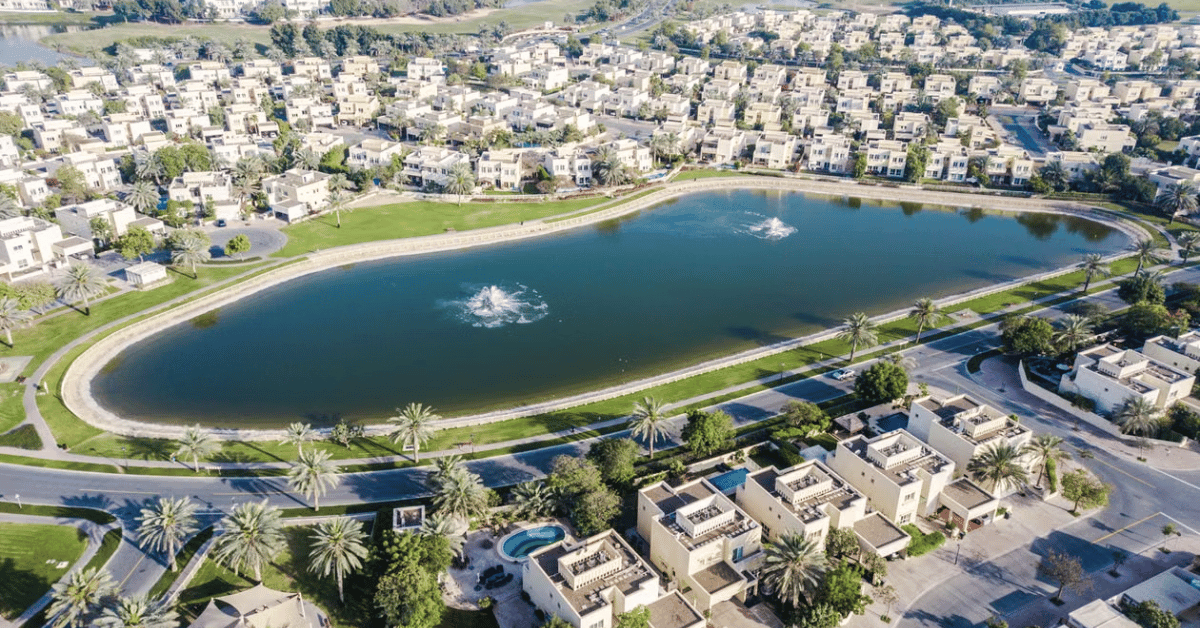
Emirates Hills is one of the areas where equity release is especially relevant. Long-standing owners often hold properties that have risen significantly in value, even though the market itself is small and slow-moving.
Location: 9 | Developer: 8 | Concept: 8 | Pricing: 4 | Rental: 5 | Appreciation potential: 6 | Liquidity: 5
Verdict: Emirates Hills owners may be particularly well placed for equity release after years of appreciation. However, in a small, slow market, the real constraint is liquidity, not value on paper.
FAQs
What's the maximum cash I can get through equity release in Dubai? Usually up to around 20% of the property value. This option is only offered by a limited number of banks, each with its own eligibility criteria.
Why are Dubai mortgage rates affected by US rate decisions? Because the dirham is pegged to the dollar. Changes in US rates pass through to the local credit market, usually via EIBOR.
Can I use equity release funds for anything? Usually not. Most routes are controlled, with the money paid directly to the developer, seller or contractor. Only certain banks offer a limited cash option.
Is now the right time to fix my mortgage rate? The answer depends, among other things, on the expected direction of US rates. A mortgage broker can help you weigh fixed against variable based on current market conditions.
Further Reading
This guide is part of Dubai Index's mortgage content hub. For the full picture, read our complete guide to mortgages in Dubai.
- Dubai LTV ratios and loan limits
- Off-plan mortgages in Dubai
- Why use a mortgage broker in Dubai
- Dubai Index mortgage and financing service
Thinking About Refinancing or Releasing Equity?
Dubai Index connects property owners with banks offering competitive refinancing and equity release terms for the current rate environment. Contact Dubai Index to explore your options.